Safer Dating Profile Verification Methods That Actually Help in 2026
Learn the safest ways to verify dating profiles in 2026, from ID checks to friend-backed social proof, video calls, and background screening.
Fake dating profiles have gotten better at looking normal, which is exactly why safer dating profile verification methods need to go beyond a shiny badge. The strongest approach in 2026 mixes identity checks, age checks, real-world context, and social proof from people who actually know you. If you want a system built around that last part, Lovebird app adds friend-backed endorsements to dating profiles so trust is not left to a clever selfie and a bio written like a hostage note.
Why profile verification matters more than a blue check
Dating apps use verification to reduce impersonation, underage access, scams, and low-trust matches. Competitor research across identity providers like Veriff and Ondato shows the same pattern: platforms now treat verification as a trust-and-safety feature, not a cosmetic extra. That shift makes sense, because dating, in the plain-language sense, is about spending time together to get to know someone for romantic or intimate purposes, so the cost of a fake profile is unusually personal.
A badge alone, though, can mean wildly different things. Some platforms verify only that a selfie matches prior photos. Others ask for a government ID and a liveness check. A few add optional screening layers, such as criminal background or credit-health signals, which can help with risk assessment but should never replace judgment.
Key takeaway: Verification is useful only when you know what was verified, how it was checked, and whether the signal can be faked or borrowed.
- Identity verification: confirms a person matches a government-issued ID.
- Age verification: checks whether someone meets the platform's age threshold.
- Liveness detection: tests that a live person, not a static image or replay, is present.
- Social verification: uses friends, references, or existing networks to add context.
- Behavioral verification: looks at ongoing activity patterns, not just sign-up proof.
If you want the broader safety playbook around matching and meeting, the guide on dating app safety in 2026 is a smart companion read.
The safest verification stack uses more than one signal
No single method catches every bad actor, so the safest setup combines document, biometric, social, and optional screening checks. This is where many articles stop at "upload your ID," as if romance fraud packs up and goes home after seeing a driver's license.
Verification methods compared
| Method | What it verifies | Best use | Main limit |
|---|---|---|---|
| Government ID check | Legal identity, often name and age | Blocking fake or underage signups | Doesn't show current intent or behavior |
| Selfie plus liveness | Real person is present during check | Stops photo spoofing and replay attacks | Can't confirm character or relationship goals |
| Video call before meeting | Real-time face, voice, and interaction | Personal screening before a date | Easy to skip, and still not proof of integrity |
| Reverse image and username search | Whether photos or handles appear elsewhere | Spotting stolen images or copy-paste personas | Manual, imperfect, and time-consuming |
| Background screening | Certain public-record risk signals | Higher-trust matching for safety-minded users | Privacy concerns and limited scope |
| Friend-backed vouching | Social proof from people who know the dater | Adds context about reputation and consistency | Works best when endorsements are specific |
What each layer catches, and what it misses
Document checks catch identity fraud better than gut instinct. Competitor pages focused on online dating identity verification consistently describe a flow of government ID upload plus selfie matching. That's useful, especially for age-gated platforms, but it mostly answers "Is this person real?" rather than "Are they trustworthy to date?"
Live interaction catches inconsistency faster than text chat. A short video call can expose a catfish, a fake accent, or someone obviously using old photos. It also gives you a reality check on chemistry, which is nice because nobody wants to spend money on a date that already feels like a clerical error.
Social proof fills the context gap. A friend endorsement doesn't replace identity verification, but it can answer things documents can't, such as whether someone is kind, reliable, or serious about dating. That's the same trust gap explored in self-written bio vs friend-vouched dating profiles, where context matters more than polish.
How to verify a dating profile yourself before you meet
You can screen a profile safely by checking consistency across photos, conversation, identity signals, and off-app behavior. User-side verification still matters because even the best platform checks are snapshots, not guarantees.
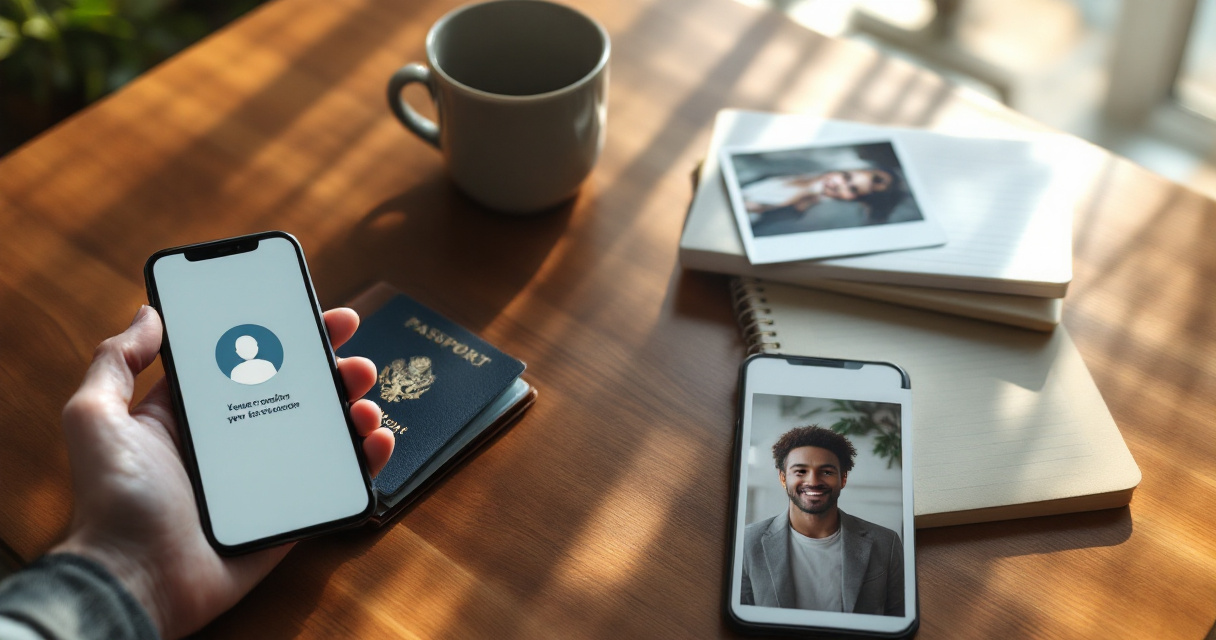
A practical five-step screen
- Check photo consistency. Look for the same face, age range, and style across all images.
- Read for specifics. Real profiles usually mention places, routines, or interests that can be discussed naturally.
- Ask for a quick video chat. A five-minute call filters a lot of nonsense.
- Cross-check social cues. Shared friends, references, or a friend-backed profile add useful context.
- Keep first meetings public. Verification lowers risk; it does not cancel common sense.
Red flags that verification badges do not fix
Some signals are behavioral, not technical. If someone dodges basic questions, pushes to move off-app immediately, or has a profile that looks oddly generic, take the hint. A verified account can still belong to a real person with bad motives, flaky behavior, or a spouse who would be very interested in this conversation.
- Refuses a video call without a clear reason
- Uses only heavily filtered or distant photos
- Shares inconsistent work, age, or location details
- Pushes urgency, secrecy, or money talk
- Gives vague answers that never get more specific
For a deeper checklist, see How to Spot a Genuine Dating Profile in 2026.
How Lovebird app handles verification differently
Lovebird app adds friend-backed social proof to profile verification, which helps answer the part ID checks can't: what this person is like in real life. That matters because a government document can confirm identity, but not whether someone is respectful, dependable, or actually dates with intention.
Why friend-backed verification stands out
The Lovebird app approach centers on endorsements from friends who know the person offline. That creates a second layer of accountability. If someone's profile is tied to people willing to vouch for them, it becomes harder to fake an entire dating persona from thin air.
This is also why the model feels more human than a sterile badge. You're not just seeing "passed check." You're getting social context, which is often the missing ingredient in dating apps built around self-description and flattering camera angles.
Best use case: Friend-backed profiles are especially useful for daters who want higher-quality matches, more intentional dating, and a little less chaos-per-swipe.
Who should pick which method
| If you want... | Best fit |
|---|---|
| Proof that a user is a real legal identity | ID plus selfie verification |
| Quick pre-date screening | Short video call |
| More context about character and consistency | Friend-backed vouching with Lovebird app |
| Extra caution for safety-sensitive dating | Optional background screening plus public first dates |
If you're curious how the endorsement model works in practice, these explainers help: what "vouched" means in dating apps and how to ask a friend to vouch for you on a dating app.
One more practical note: thelovebird.co is worth a look if your biggest complaint about dating apps is that everyone sounds amazing on paper and mysterious in real life.
What smarter verification will look like through 2027
Dating verification is moving from one-time checks toward layered, ongoing trust signals. Competitor coverage already points to broader safety stacks, especially around age checks, liveness, and platform trust. The next step is not just stronger onboarding, but smarter monitoring after the badge is awarded.
What to expect next
- More layered verification: platforms combining ID, liveness, and social proof
- More age-focused controls: especially where underage access is a platform risk
- Clearer trust labels: showing what kind of verification a badge actually represents
- Optional deeper screening: background and related risk checks for users who want them
Why transparency matters
Research quality in safety systems depends on clear reporting standards. While not dating-specific, the reporting framework described in PRISMA 2020 explanation and elaboration is a good reminder that methods matter as much as conclusions. For dating apps, that means users should be told whether a badge means photo matching, government ID verification, age verification, or something richer.
The best platforms will probably win by being explicit, not mysterious. Users are more likely to trust a system that says exactly what was checked. Vague badges feel sleek, but sleek is not the same as safe. More on that idea, plus practical examples, lives on thelovebird.co and in the broader dating guide.
Conclusion
Safer dating profile verification methods work best when they layer identity proof with human context. Start with platform checks like ID, age, and liveness verification. Add your own screen with a short video call and a public first meeting. Then, when possible, choose profiles with real social proof, because trust built from actual relationships beats a lonely badge trying to do all the work.
If you want a dating app built around that idea, try Lovebird app and compare it against your current setup. Read a few friend-vouch examples, ask someone in your circle for an endorsement, and use a profile that gives matches more than marketing copy. Safer dating gets easier when your profile can be verified by both systems and people.